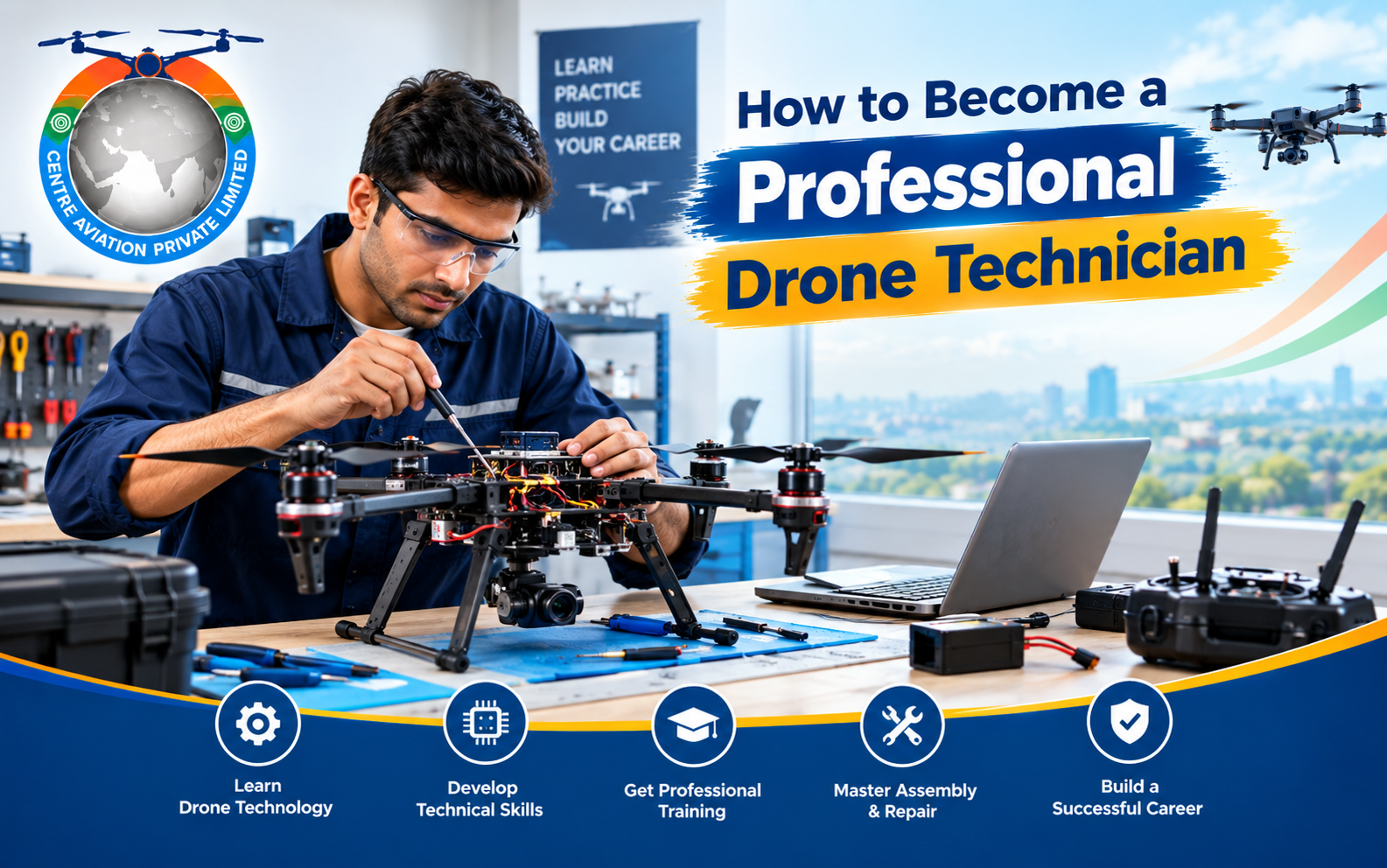
Drones are becoming an important part of many industries in India. They are now used for aerial photography, surveying, agriculture, mapping, construction, inspection, defence, research, and many other applications. As the use of drones is growing, the demand for trained professionals who can assemble, repair, maintain, and troubleshoot drones is also increasing.
If you enjoy working with electronics, mechanical systems, and modern technology, you can consider becoming a professional drone technician. A professional drone technician is a person who ensures that a drone is safe and fit for operations.
This guide discusses how to become a professional drone technician, what skills to develop, what training to consider, and how to pursue a career in this growing field.
What Does a Drone Technician Do?
A drone technician works on the technical side of unmanned aerial vehicles. Their responsibilities can include drone assembly, maintenance, inspection, troubleshooting, component replacement, calibration, and testing.
A technician can work with various components, including:
- Motors and propellers
- Flight controllers
- Electronic speed controllers
- Batteries and charging systems
- GPS modules
- Remote controllers
- Sensors
- Cameras and other payloads
- Communication systems
- Wiring and electronic connections
A good technician must understand how the components function and be able to identify technical problems and solutions.
Why Consider a Career as a Professional Drone Technician?
The Indian drone industry is growing rapidly and providing numerous opportunities for those with technical and practical skills. Companies in drone manufacturing, surveying, agriculture, inspection, mapping, training, and drone services require technicians who understand the complete drone system.
A career in this industry can be suitable for students, engineering graduates, electronics enthusiasts, hobbyists, and professionals who want to enter the drone industry.
Instead of learning only the theoretical concepts, aspiring technicians should focus on practical training. Hands-on experience with real drone components can make understanding assembly, maintenance, and troubleshooting easier.
Step 1: Learn the Basics of Drone Technology
The first step is to understand how a drone works. Before working on advanced repairs, you need to be familiar with the basic parts and their functions.
Learn about:
- Different types of drones
- Multirotor and fixed-wing aircraft
- Drone frames
- Motors and propellers
- Flight controllers
- ESCs
- Batteries
- GPS and navigation systems
- Radio communication
- Sensors
- Payload systems
- Basic electronics
A good foundation will help you understand technical problems more easily later in your career.
Step 2: Develop Electronics and Mechanical Skills
Drone technology uses electronics, mechanical systems, software, and aerodynamics. Therefore, a professional technician should have knowledge in these fields.
Basic electronics knowledge can help you understand wiring, connectors, voltage, current, circuits, batteries, and electronic components. Mechanical knowledge is also important because drone technicians regularly work with frames, motors, propellers, landing systems, and other components.
Learning these skills through practical projects can significantly boost your confidence.
Step 3: Get Professional Drone Technician Training
Self-learning can provide useful knowledge, but structured training can provide you with a more organized understanding of drone technology.
A drone technician course can introduce you to important areas such as drone assembly, maintenance, troubleshooting, component testing, and repair procedures.
For those looking for specialized technical education, drone repair and maintenance courses in India can provide you with practical exposure to the systems used in modern drones.
When selecting a training program, look for a course that will give you hands-on practice instead of focusing only on classroom theory.
Step 4: Learn Drone Assembly
Drone assembly is one of the most important skills for a technician. You must understand how individual components are selected, installed, connected, and tested.
Drone Assembly Training in India can help students understand the complete process of building a drone from its basic components.
During practical training, you may learn how to:
- Assemble a drone frame
- Install motors
- Mount ESCs
- Connect a flight controller
- Install GPS and other sensors
- Connect the power system
- Configure the required components
- Check wiring and connections
- Test the completed aircraft
Proper assembly is important because incorrect installation can affect flight performance and safety.
Step 5: Learn Drone Repair and Troubleshooting
Repair and troubleshooting are essential skills for anyone who wants to work professionally as a technician.
A drone can develop problems because of crashes, component failure, battery issues, loose connections, software configuration problems, or normal wear and tear.
A trained technician should be able to identify the source of a problem instead of simply replacing parts.
A drone repairing course in India can help learners understand common technical faults and develop systematic troubleshooting skills.
Some common problems technicians may encounter include:
- Motor failure
- Damaged propellers
- Battery problems
- GPS errors
- Communication issues
- Flight controller problems
- Wiring faults
- Sensor errors
- Unusual vibrations
- Calibration issues
The ability to diagnose these problems efficiently can make a technician more valuable to employers and drone service companies.
Step 6: Understand Drone Maintenance
Regular maintenance can help improve the reliability and operating life of a drone. A technician should know how to inspect important components before and after operations.
A drone service technician course can be useful for learning systematic maintenance practices and technical inspection procedures.
Maintenance activities may include checking motors, inspecting propellers, examining wiring, testing batteries, cleaning components, checking firmware and configuration, and identifying signs of physical damage.
Technicians should also maintain proper service records so that repairs and maintenance activities can be tracked.
Step 7: Learn Aeromodelling and Practical Flight Concepts
Aeromodelling is another useful area for those interested in becoming drone technicians. It can help learners understand basic principles related to aircraft structure, balance, aerodynamics, propulsion, and flight.
A DGCA Approved Drone Aeromodelling Course can provide an opportunity to explore these concepts through practical learning and model-building activities.
For learners in the region, a Drone Aeromodelling Course in Gurgaon can be a useful way to gain hands-on exposure to aircraft design and related technical concepts.
Aeromodelling knowledge can complement drone technician training because it helps students understand why aircraft behave differently depending on their design, weight, propulsion, and configuration.
Step 8: Build Practical Experience
Technical skills become stronger through practice. After learning the fundamentals, work on small projects and gradually move toward more complex systems.
You can practice by:
- Building a basic drone.
- Disassembling and reassembling components.
- Testing motors and batteries.
- Learning basic soldering.
- Checking wiring and connectors.
- Performing routine inspections.
- Diagnosing common faults.
- Testing repaired components.
- Maintaining technical records.
Practical experience will help you develop confidence and improve your problem-solving ability.
Step 9: Consider Drone Certification and Pilot Knowledge
Although a technician primarily focuses on the technical side, understanding drone operations can also be beneficial. Knowing how pilots operate drones can help technicians understand the practical requirements of different aircraft.
Students interested in expanding their knowledge can explore Drone Certification Courses and professional drone education programs.
For those who want broader industry knowledge, Professional Drone Courses in India can offer exposure to different aspects of the drone ecosystem.
Pilot training and technician training are different career paths, but having knowledge of both can give a professional a wider understanding of drone operations.
Step 10: Choose the Right Drone Training Institute
The quality of your training can have a major impact on your technical skills. When selecting an institute, consider factors such as practical training, experienced instructors, workshop facilities, equipment, course structure, and industry relevance.
People searching for the Best Drone Training Institute in India should compare institutes carefully instead of choosing a course only because of its name or advertising.
Similarly, students looking for the Best Drone Training Institute in Gurgaon should check whether the institute provides adequate hands-on exposure to drone assembly, repair, maintenance, and testing.
A good training environment should allow students to work with actual equipment and understand real-world technical situations.
Drone Training at Tras Aviation
Tras Aviation provides training opportunities for learners who want to develop practical knowledge in the growing drone industry. The training approach can help students explore areas such as drone technology, assembly, maintenance, repair, and aeromodelling.
For learners interested in Advanced Drone Training India, choosing a program with practical exposure can be an important step toward developing industry-ready skills.
The goal should not be limited to completing a course. Students should focus on developing technical knowledge that they can apply in real working environments.
Career Opportunities for Drone Technicians
After gaining suitable training and practical experience, a drone technician can explore opportunities in different areas of the drone industry.
Possible career roles include:
- Drone Technician
- Drone Repair Technician
- Drone Maintenance Technician
- Drone Assembly Technician
- UAV Service Technician
- Drone Manufacturing Technician
- Drone Workshop Technician
- UAV Testing Assistant
- Drone Field Service Technician
Technicians may find opportunities with drone manufacturers, service companies, surveying companies, agricultural technology companies, training organizations, research institutions, and other businesses using drones.
Skills You Should Develop
A successful drone technician needs more than technical knowledge. Some important skills include:
Technical Skills
You should understand electronics, mechanics, batteries, motors, flight controllers, sensors, wiring, and basic drone configuration.
Troubleshooting Skills
You should be able to identify problems logically and test components before deciding what needs to be repaired or replaced.
Attention to Detail
Small mistakes in wiring, component installation, or inspection can affect drone performance. Careful work is therefore extremely important.
Safety Awareness
Technicians should follow safe practices when working with batteries, electrical systems, motors, propellers, and aircraft.
Communication Skills
A technician may need to explain technical problems to pilots, customers, engineers, or other team members. Clear communication can make technical work more effective.
Is Drone Technician Training Difficult?
Drone technician training can be challenging because it combines several technical areas. However, beginners can learn the fundamentals step by step.
You do not need to understand every technical concept before starting. A structured learning path can help you progress from basic concepts to advanced troubleshooting.
Start with drone components and basic electronics. Then move into assembly, configuration, maintenance, repair, and testing. Regular practical work will help you improve faster.
How Long Does It Take to Become a Drone Technician?
The time required depends on your previous technical knowledge, the type of training you choose, and how much practical experience you gain.
A beginner should focus on learning the fundamentals first and then develop practical skills through projects and workshop training. The objective should be to become capable of independently inspecting, maintaining, assembling, and troubleshooting drones.
Continuous learning is also important because drone technology is developing rapidly.
Start Your Drone Technician Career
Becoming a professional drone technician can be a rewarding career path for people who enjoy technology and hands-on technical work. The most important steps are to understand drone systems, develop electronics and mechanical skills, complete practical training, learn assembly and repair, and gain real-world experience.
If you are looking for a structured path, Tras Aviation can be considered as a training option for developing practical knowledge in drone technology, repair, maintenance, assembly, and related areas.
From learning the fundamentals to developing advanced technical skills, the right training can help you build a strong foundation for a career in the expanding drone industry.
Whether your goal is to become a drone technician, work in drone repair and maintenance, enter drone manufacturing, or expand your knowledge of UAV technology, starting with quality practical education is an important first step.

Related Posts