
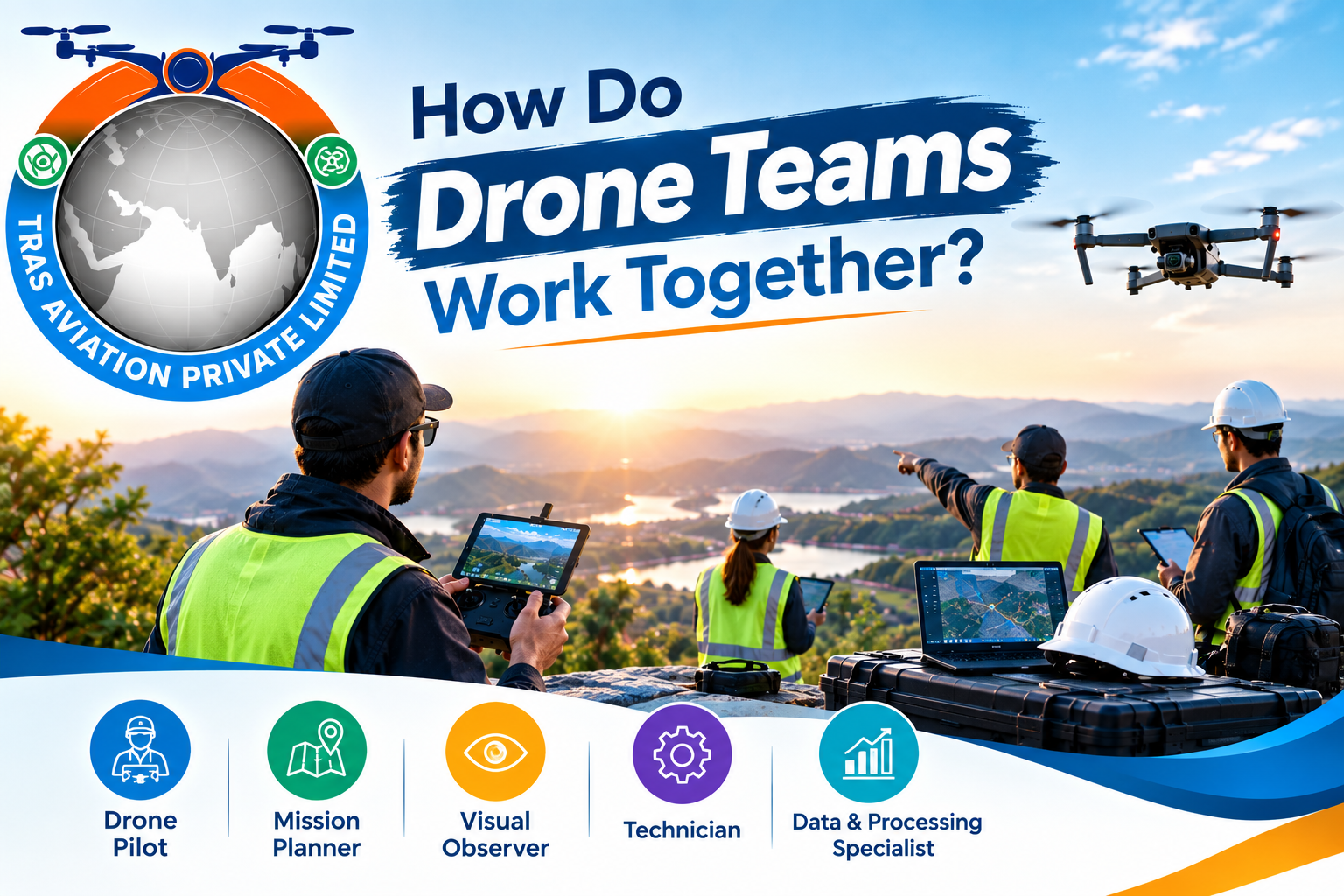
Drones are no longer a novelty, and their use extends far beyond the sphere of photography. Such devices find their application in surveying, mapping, construction, farming, inspection, and even in aerial photography.
However, a single drone operator is unlikely to manage all the intricacies of a drone mission successfully.
A drone project always involves a team of people who help each other accomplish complex tasks safely and efficiently.
Why Teamwork Matters in Drone Operations
The process of operating a drone is by no means a trivial one, even for professional teams. A drone project may consist of numerous stages, including learning the client’s requirements, studying the site conditions, inspecting and preparing the equipment, flying the drone, studying the drone environment, obtaining the required information or photographs with the drone, and analyzing the results.
Thus, if an operator tries to cope with all aspects of a drone mission on their own, this may lead to errors and omissions. However, an organized team can distribute tasks among its members and achieve high efficiency in drone operations. This is why teamwork plays a significant role in professional drone operations.
Key Roles of a Drone Team
Every member of a drone team has their strengths and weaknesses, and the team’s structure is determined by the project’s requirements. While some relatively simple tasks can be accomplished by a single person or a two-member crew, more complex missions require a multi-skilled team.
Let us take a look at the key roles that are often involved in a drone team.
Drone Pilot
Obviously, someone has to control the drone in order to accomplish the mission objectives. This duty falls to the drone pilot, who prepares the drone for flight and monitors its status during the flight. In addition, a pilot is responsible for ensuring that the drone maintains a safe distance from objects and people on the ground. A pilot should also be aware of the drone’s battery status at all times.
Moreover, in order to complete the mission successfully, a pilot needs to have a clear understanding of the task at hand. For instance, the flight plan for mapping purposes will differ from the one intended to capture photographs.
Those who want to develop a comprehensive understanding of all aspects of drone flight and obtain the necessary license can enroll in DGCA Drone Pilot Training courses.
Flight Planner or Mission Planner
A drone cannot fly anywhere at will, especially on a professional level. Someone needs to plan the flight and define specific parameters, and this is the responsibility of a mission planner.
In addition to choosing the flight plan, this person determines how the drone will cover the site and how many shots it will take. If the drone mission is relatively complex, the planner will also take into account restrictions, such as site boundaries, flight altitudes, and potential obstacles.
Thus, a person who takes on the role of a flight planner allows the operator to save time and effort while setting up the drone for the mission.
Visual Observer
The visual observer ensures that the drone maintains a safe distance from all objects on the ground during the flight. In addition, such a person warns the pilot about potential hazards in real-time so that the drone can avoid them.
A drone visual observer is necessary when working in complex conditions, for instance, in large-scale areas or over rough terrain.
By designating an experienced observer, the operator gets an additional set of eyes that can help them complete the mission safely.
Drone Technician
A professional-grade drone can malfunction under certain conditions, so there is always a need for a qualified technician. In general, this role covers persons who can maintain and service the drone in accordance with the technical requirements.
Depending on the specifics of the mission and drone model, a technician may inspect and service various components of a drone, such as the engine, rotors, batteries, electrical circuits, onboard computer, frame, and others.
Anyone who wants to gain the skills and knowledge to maintain aircraft can enroll in Drone Repair and Maintenance Courses in India. In addition to providing fundamental insights into the intricacies of drone mechanics, such training programs also teach students to quickly identify and eliminate various malfunctions.
Thanks to their skills, drone technicians can save the crew both time and money by preventing potential malfunctions.
Data and Processing Specialist
The drone can collect the required information, but someone needs to process and analyze the data it stores. All photographs and other data that the drone captures during the flight must be sorted and organized in a particular way so that the client can use them afterwards.
This task falls to the data and processing specialist, who can edit and compile the necessary documents for the operator.
Depending on the specifics of the mission, such a person may process aerial photographs, video content, survey data, topographic surveys, 3D models, and many other types of information.
Moreover, a data specialist can edit the resulting files, extract the necessary data from them, and prepare the final version of the document for the client.
In fact, it is the data specialist who demonstrates how multifaceted drone operations can be, since this role involves not only flying the drone but also analyzing the information it provides.
How Does a Drone Team Communicate and Cooperate?
An efficiently structured team knows that communication is the key to success. Before launching the drone, the crew must discuss the objective and plan their efforts so that all mission stages are completed safely and on time.
In particular, the team should have a clear idea of the client’s requirements, the objective of the mission, the equipment to be used, the characteristics of the site, the rules for operating the drone, and many other details.
For instance, if the objective is to monitor a construction site on a regular basis, then the drone team will consist of the following members:
Project Manager
Such a person is normally required whenever the client’s objectives are particularly complex or multifaceted.
Flight Planner
This team member determines how exactly the drone will cover the site and which flight plan will be used.
Drone Pilot
The pilot flies the drone in accordance with the established flight plan.
Visual Observer
Such a person ensures that the drone does not approach any objects too closely.
Technician
This team member prepares the drone for the flight and monitors its technical state.
Data Specialist
The data specialist processes the photographs stored on the drone.
Each team member has their responsibilities, but they are united by the common goal, which is set by the project manager. It is the manager who defines the objective that the drone team is to accomplish. Moreover, it is the manager who develops an efficient strategy to meet the objective.
Cooperation within a team is also of particular importance, which is why it is crucial to pay special attention to communication. Ideally, team members should consult with each other not only before the mission but also during the flight, since this allows them to quickly respond to changing circumstances.
For instance, if the visual observer notices an obstacle, they should inform the pilot so that they can divert the drone in time. Moreover, if the technician discovers a problem with the drone equipment, they should notify the crew so that the issue can be resolved.
In general, communication enables the team to quickly adapt to new conditions and respond to challenges.
Prioritizing Safety Over Data Collection
When working with a drone, a team should always prioritize safety over data collection. Thus, before flying the drone, the crew should consider the weather forecast, battery power, potential obstacles, objects and people on the site, takeoff and landing zones, equipment inspection, and the emergency response plan.
In other words, the crew should conduct a hazard analysis to identify potential risks.
In addition, team members should also be prepared to update the flight plan if circumstances change.
A qualified drone team knows that sometimes it is better to abort the flight rather than put people and equipment at risk.
Understanding the importance of safety is an integral part of any pilot’s training.
Learning the Art of Collaboration in a Drone Team
Professionals in the drone industry can operate a drone, plan and analyze flights, and service drone equipment. However, such persons also know how to work with other team members because collaboration is essential in a drone team.
Thus, it is a good idea to enroll in a professional training course to learn the fundamentals of drone operation.
By obtaining knowledge of drone operations, students can see the bigger picture and understand the intricacies of each role within a drone team. At the same time, collaboration with other students allows them to learn how to work in a team and see the responsibilities of each team member.
Thus, it is a good idea to enroll in a professional training course to learn the fundamentals of drone operation. Students interested in practical drone learning can also explore a Drone Aeromodelling Course in India to develop a better understanding of drone design, construction, and operation.
The Multifaceted Nature of Real-World Drone Operations
Flying a drone is only part of a larger process, the full scope of which can be overwhelming for an unprepared mind. In reality, a drone project consists of multiple steps, ranging from preparing the site to analyzing the drone data.
All such tasks are accomplished by a team of professionals who are responsible for various aspects of a project. Thus, teamwork is essential when operating a drone because such an approach helps accomplish complex tasks safely and efficiently.
The Importance of Teamwork in a Drone Team
The division of responsibilities among team members allows each person to focus on a specific part of the drone project. For instance, while the pilot flies the drone, the technician prepares the equipment, and the data specialist sorts and edits the drone data.
Moreover, such an approach to drone operations also increases efficiency because the crew can utilize the skills and knowledge of all team members.
In addition, it is worth noting that collaboration allows professionals to specialize in a certain area while continuing to develop their skills. This is especially important in the drone industry, where the demand for qualified workers is growing exponentially.
The Future of Drone Teams
As the capabilities and scope of drones keep expanding, so do the roles and responsibilities of a drone team. Such a team will always comprise individuals with different skills and qualifications.
As for the future, the drone teams of tomorrow will involve professionals who can operate cutting-edge technology, such as innovative sensors, automated flight systems, artificial intelligence, augmented reality, and many others.
However, even the most advanced drones will require human expertise to ensure safe and efficient operations.
Thus, the ability to collaborate with others will continue to be vital for any drone operator because such projects involve the combined effort of multiple people.
Conclusion
Drones are complex devices, and their operation involves various responsibilities. A drone team enables operators to accomplish tasks safely and efficiently by distributing responsibility among team members.
Each person in the team should know their role and follow all rules to ensure the safety of the mission.
Those who wish to work in the drone industry should understand the intricacies of drone operations. Tras Aviation offers a variety of training programs that introduce students to the fundamentals of drone operation.

Related Posts