The drone industry in India is well developed enough to provide careers beyond just drone piloting. There are many drone agriculture, drone mapping, drone survey and inspection, drone photography, and infrastructure jobs.
The ability to assemble a drone is the first step towards understanding and constructing automation or control systems. Through Drone Assembly Training in India, participants are provided insight and understanding of constituent subsystems of a drone, assembly, and flight test of the system.
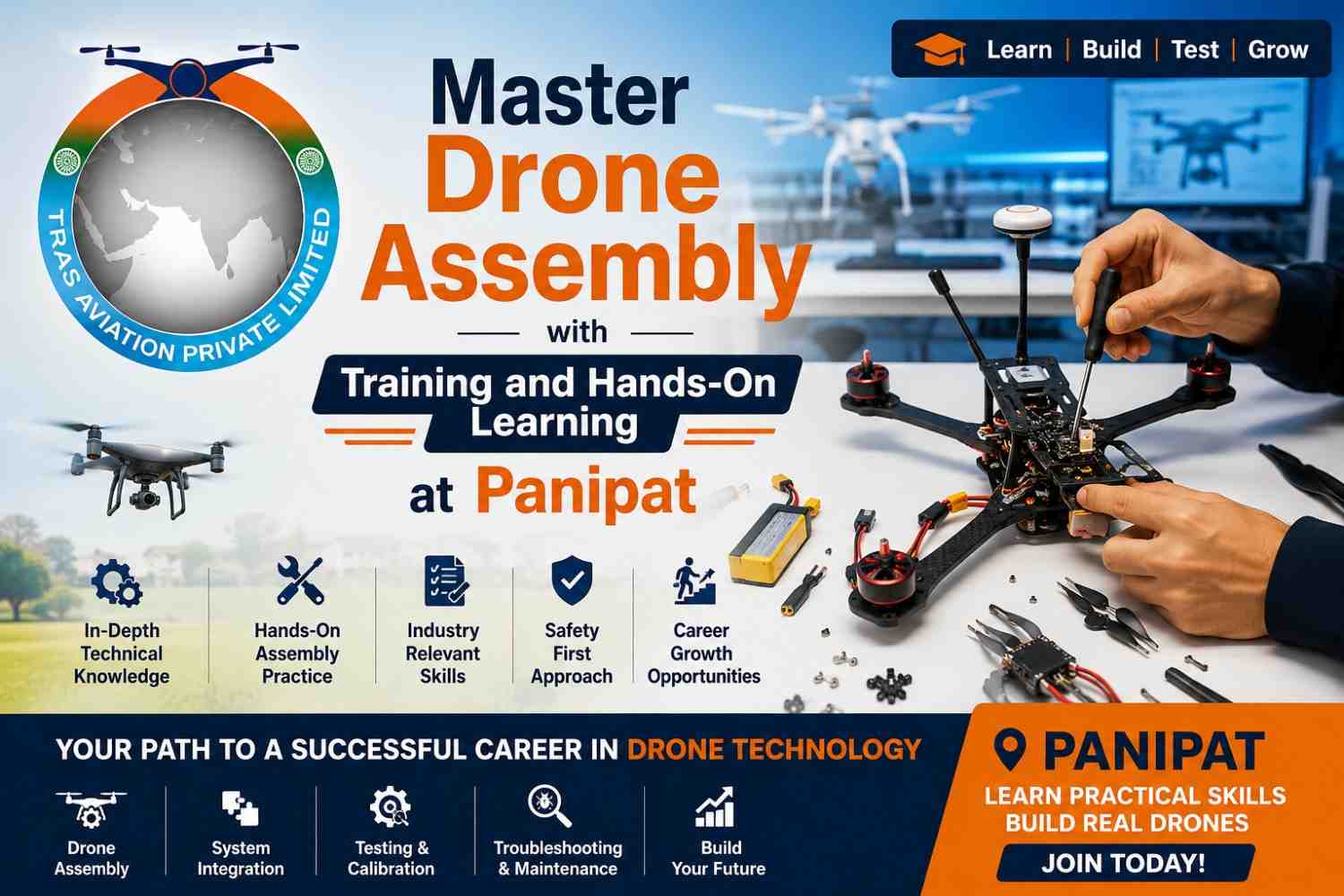
Training in drone assembly offered in Panipat is the first of its kind offered in India. TRAS Aviation offers training for participants interested in a career in drone technology.
Why Panipat?
New developments in manufacturing, logistics, and infrastructure have made Panipat a premier location to new opportunities in automation and technology. As more and more industries are expected to use drone technology, Panipat will become the prime location for drone technology training.
Training offered with drone assembly, is deeper and wider than just flying a drone. Focus is on understanding a system and controls and on safe operation.
A drone assembly course provides students with:
- Knowledge on how to assemble drone frames.
- Experience on how to assemble motors and propellers.
- Familiarity with installing and programing electronic speed controllers (ESCs), and flight controllers.
- Background on how to assemble power systems, GPS modules, and adaptor systems.
- Insight on how to assemble drone upgrade and payload systems.
- Ability to conduct basic troubleshooting and calibrate system components.
- Experience performing system testing and adjusting system components.
- Hard-earned knowledge on how to carry out systems and sub-systems maintenance.
- Knowledge on how to assemble and wire control systems.
- Understanding on how to assemble and integrate payload systems.
They gain the ability to conduct basic troubleshooting and calibrating system components.
Each component of a drone fulfills a specific function and serves a unique purpose. Understanding these elements provides students with a baseline knowledge to build upon for understanding how drones function as a complete unit.
What is Drone Assembly Training?
Drone assembly training is an instructional method used to teach learners how drones function and how to assemble, control, and maintain drone systems. Students will learn how to assemble and understand the functions of the components of the drone system, the construction process, and how to control the systems and perform basic system checks.
The goal is to equip learners with the necessary knowledge to work within the drone manufacturing, assembly, and maintenance sectors, as well as in client service and support roles pertaining to associated industries.
Why is Hands-on Training Valuable for Technical Concepts?
For beginning learners, working with drone system components is the most effective method of teaching each function and how to perform them.
To understand how drones function and how each system and component serves a unique purpose in that function, learners must understand the fundamentals of drone systems.
Analysis of the Drone Frame
Building drones requires understanding of the drone frame. Students learn how to construct the frame of a drone by understanding how the different frame parts fit.
Geometric relationship of frame components and their position, as well as the overall frame stability and balance can determine how well a particular drone performs.
Positioning of Motors and Propeller Blades
Drone frames need to be designed to fit specific motors. Students learn how to position motors and where to place propeller blades along with the construction of the drone frame and how to connect the motors and conduct some safety checks.
It is also important to ensure that systems are fully built and installed correctly. Minor mistakes can ultimately affect the performance of a system.
Installing the Flight Controller
The flight controller is the main control system of a drone. Students learn how to properly install a flight controller, connect some basic components to the controller, how to calibrate and perform other basic configurations and how to control the drone.
Power Systems
Operation of a drone requires a power system to run the electronics and control the flight components, which is a battery and power distribution system along with basic safety precautions.
Wiring and Electronics
Training in drones can further be extended to wiring and connection of some systems and components where students learn the rationale for power distribution and how different electronic systems and components communicate.
Understanding wiring also helps in troubleshooting different wiring issues.
Hands on Learning
Building something is an effective way of learning.
Reading a component’s description aids builders in understanding the build process. Building a drone shows how various components come together.
Various aids for builders include:
- Part identification.
- Specification identification.
- Framing.
- Motor framing and installation.
- Propeller framing and installation.
- ESC framing and installation.
- Power system framing and installation.
- Flight controller framing and installation.
- Sensor framing and installation.
- System checking.
- Basic system calibrations.
- Testing the drone.
- Identification of common problems.
Exposure to building drones helps with several skills such as concentration and problem-solving.
Why Professional Drone Courses in India?
India’s fast-growing drone ecosystem has given birth to the need for many new specialized course offerings. One can opt for pilot training, technical training, assembly courses, maintenance training, surveying courses, mapping training, or training specific to other industry drone applications.
Professional Drone Courses in India provide learners an idea of how drone technology is used in various industries and applications.
Based on interest, students can pursue the following:
- Drone Pilot Training
- Drone Assembly
- Drone Maintenance and Repair
- Drone Surveying
- Drone Mapping
- Drone Photography
- Agricultural Drone Operations
- Drone Inspection
- Drone Technology
- Advanced Drone Applications
Based on your interest and preference, you can opt for any combination.
The maintenance training program introduces students to Routine Inspections, Motor Checks, Propeller Inspections, Battery Checks, Wiring Inspections, Frame Inspections, Sensor Inspections, Inspections of the Flight Controller, Component Testing, Basic Troubleshooting, and more.
Routine Inspections are important as Drone components are complex with many mechanical, electrical, and electronic components.
In the case of failures during Drone operation, some level of technical familiarity will help students to understand and identify issues before they create large operational concerns.
Training in Drone Assembly for Potential Technicians
There are career opportunities beyond Drone piloting. Drone assembly and maintenance, as well as other supporting activities, require a good level of technical knowledge.
Interests in Mechanics, Electronics, Robotics, Aviation, and/or Troubleshooting will be strong motivators for Drone assembly.
A Drone Technician provides support to a Drone Operator, Service Provider, Manufacturer, or End User, as they work with different subsystems and components.
Technical skills include Component identification, Assembly, and Electrical connections, Equipment assessment, Trouble shooting, and Preventative Maintenance as well as Basic Repairs, Systems Checks, and System Calibration.
Drone Technicians with some work experience and the skills outlined are better placed for entry level positions in the industry.
Safety During Drone Assembly Training
Drones contain motors, batteries, and various tools and equipment. Incorrect assembly or poor handling creates unsafe situations as well as damage to equipment. To this end, safety must be a priority in drone assembly training.
Learners should be familiarized with workplace safety practices when it comes to the following:
- Handling batteries safely
- Tool safety
- Safe motor and propeller testing
- Safe component checks
- Testing safety
- Electrical safety
- Safe equipment storage
- Preliminary checks
Safety knowledge is extremely important throughout the entire construction process and when preparing to fly a drone for the first time.
Drone Assembly and Flight Training
Understanding the assembly process helps with flight training. A pilot who understands how a drone is assembled understands the components of the system they are controlling.
Knowing the function of the motor, propeller, battery, sensor, control, and other system elements, and how they relate to the construction of the system, helps understand the checks done prior to a flight.
A combination of technical and operational knowledge is useful for learners who wish to develop advanced drone skills.
Assembly training and certification of drone pilots are two distinct pathways. Students must understand the pathway that a training program offers and how that pathway meets the qualification or certification requirements.
Who Should Consider Joining Drone Assembly Training?
There are many types of learners who would find drone assembly training useful, such as:
- Individuals interested in drone technology
- Individuals interested in electronics
- Learners of engineering
- Learners of robotics
- Students of aviation technology
- Individuals interested in becoming drone technicians
- Existing drone pilots
- Individuals interested in starting a drone business
- Maintenance professionals
- Technology professionals
- Individuals interested in drone manufacturing
Prior technical experience may not necessarily be a requirement for beginner level training. With a good assembly training program, the concepts of assembly can be introduced in a safe and easy progressive manner.
Career Opportunities After Drone Assembly Training
The drone industry has many different technical and non-technical career routes to choose from.
DRONE ASSEMBLY TECHNICIAN
As a drone assembly technician, you can focus on the construction and integration of drone systems and components.
REQUIRED SKILLS
- Understanding of how mechanical and electronic equipment and systems work
- Ability to interpret and understand relationships and the nature of connections from blueprints
- Ability to interpret and understand 2D drawings and technical manuals
- Ability to understand and integrate systems and components to build and integrate multiple systems
- Understanding of the equipment and how it operates
- Excellent problem solving skills
TESTING ASSISTANT
Learners can test systems and assist with finding system issues.
TECHNICAL OPERATIONS
A drone operator with basic knowledge of assembly and maintenance will gain a deeper understanding of operating technology.
ENTREPRENEUR
There are options for a new business in: assembly, repair, maintenance, training, surveys, photography, and other services.
The actual opportunities an individual gets will depend on their qualifications, experience, specialization, skills, practical abilities, and applicable laws.
How to Choose the Right Drone Assembly Course
Choosing a drone assembly course is important. Comparing the different programs available also helps. Below are some tips you can use when comparing the available programs.
- Design
- Length of the training course
- Training equipment
- Training systems
- Training projects
- Testing methods
- Safety training
- Experience of training instructors
- Recognition of training or certificates
- Counseling on job opportunities
CAREER EXPOSURE
Consider whether the course is beginner and if enough practical time will be given.
An assembly-only course (theory only) may not be as useful as a complete course in which learners get an opportunity to assemble a drone and a system for testing.
Why TRAS Aviation?
TRAS Aviation focuses on providing learners with hands-on practical training in a structured and well-organized manner for technical operational skills. TRAS Aviation will provide drone system training in the field and drone assembly, testing, and maintenance training.
Knowing that dgca approved drone training institute authorization is for some training organizations as well as certain remote pilot training pathways is important. A student must confirm that the approval is valid and check the scope and range of the program.
Among Drone Certification Courses, Professional Drone Courses in India, and Drone Assembly Training in India, what is most important is that the training is in line with the chosen career pathway.
Build Your Technical Future with Drone Assembly Training
With the Indian drone industry growing in almost all sectors like agriculture, infrastructure, surveying and mapping, construction, inspection, photography, logistics, and even in related sectors, the Indian drone ecosystem is growing fast, as is the number of job opportunities. Understanding drones will give job seekers an edge.
The ability to construct a drone is a unique opportunity to learn about the structures and systems behind flight. Instead of simply viewing drones as flying objects, students will learn about the systems and maintainance of a drone.
For students in Panipat and the surrounding areas, practical Drone Assembly Training in India is a fantastic opportunity to enter a technical career in the drones sector.
If you want to be a professional drone maintainer, or want to be a highly skilled drone professional, want to be a drone entrepreneur, or want to be a drone professional with a lot of specialized knowledge, the hands on approach to learning is the best way to go.
TRAS Aviation offers career focused drone education. Their programs are designed to help learners feel confident, build hands on skills, and train them for a specific career path. Building a successful career in the booming drone sector of India can take many different steps. Some of these steps are understanding and committing to the sector, hands on experience, directing the technology used, and building the skills required.
Answers to Your Top Questions
1. What is Drone Assembly Training in Panipat?
Drone Assembly Training in Panipat is a hands-on training program that teaches learners how to identify, organize, link an fuse together, configure, test, and maintain an individual function of a drone unit.
2. What do you learn in Drone Assembly Training in India?
With this drone training, learners gain understanding of the drone frame, motors, propellers, batteries, flight controller, ESCs, sensors, and how to configure the wiring and the drone’s power system and conduct some basic troubleshooting.
3. Who should join Professional Drone Courses in India?
Individuals interested in the drone technology sector such as students, keen engineering students, hobbyists interested in the sector, aspiring drone technicians, drone pilots, entrepreneurs, and drone enthusiasts should join Professional Drone Courses in India.
4. Are Drone Certification Courses useful for a drone career?
They are very useful. Other than hands on experience, these courses provide a systematic approach on how to operate drones safely and provide a career path in drone operations.
5. What is the career scope after drone assembly training?
After completion of drone assembly training, one can become a drone assembly technician, maintenance technician, repair technician, test assistant, drone operator, or a drone entrepreneur.
6. Why choose TRAS Aviation for drone training?
Our practical approach will give you the skills to construct, repair and employ your drones. Career focused learners can now build their drone skills and can anticipate fulfilling their aspirations.

Related Posts