The booming Indian drone sector is creating various aviation jobs. If you are interested in a fast-paced work environment and love problem solving, the field of drone technology may be for you. This sector is creating opportunities for different demographics including students, working professionals, entrepreneurs, enthusiasts, photographers, surveyors, and people who want to engage in technology. Drone technology can be integrated into the construction, agricultural, and other inspection fields, and can be used for surveying or mapping.
As demand for skilled drone professionals increases, choosing the right training institution for professional drone piloting is vital. A Drone training Institute in South Delhi should teach learners how to fly drones, but should be more about building a drone professional through a thorough understanding on drone safety, flight equipment, regulations, flight planning, and other operations.
A great place to start for aspiring professional drone pilots is South Delhi. South Delhi is a great location for convenient access to professional training. TRAS Aviation offers a great platform for aspiring pilots to begin their training.
Why South Delhi?
The real estate, education, infrastructure, media, technology, and construction industries are located in South Delhi. These sectors are some of the first to integrate drone technology to further their professional activities.
Self-learning does not always provide the structure needed to prepare learners for the challenges of flying a drone. Learners need to prepare drones, perform equipment checks, learn flight controls, safety procedures, and learn to manage any challenge that may occur during operational drone flights.
A great training program can show trainees what various professional opportunities they can pursue. Students can consider a career in drone piloting, surveying, mapping, photography, inspections, agriculture, maintenance, and technical services.
For someone planning a long-term career, practical exposure is important because professional drone operations require a lot of confidence, discipline, and technical knowledge.
What Makes the Best Drone Training Institute in India?
When someone is searching for the Best Drone Training Institute in India, the name of the institute and course certificate are not the only issues to consider. The quality of training, the extent of practical exposure, trainers’ experience, equipment, safety training, and career focus are the main issues to consider.
A good drone training program would have the following:
- Classroom-based learning
- Practical flight training
- Equipment training
- Pre-flight and Post-flight
- Safety and emergency
- Airspace
- Weather and Environments
- Maintenance
- Planning
- Applications
- Certification
The DGCA’s training (remote pilot) covers air laws and regulations, airspace, flight, meteorology, and maintenance, assessment of risks and emergencies, and payloads and analysis.
So, learners should choose a program that integrates both knowledge and skill.
Training for Professional Drone Pilots
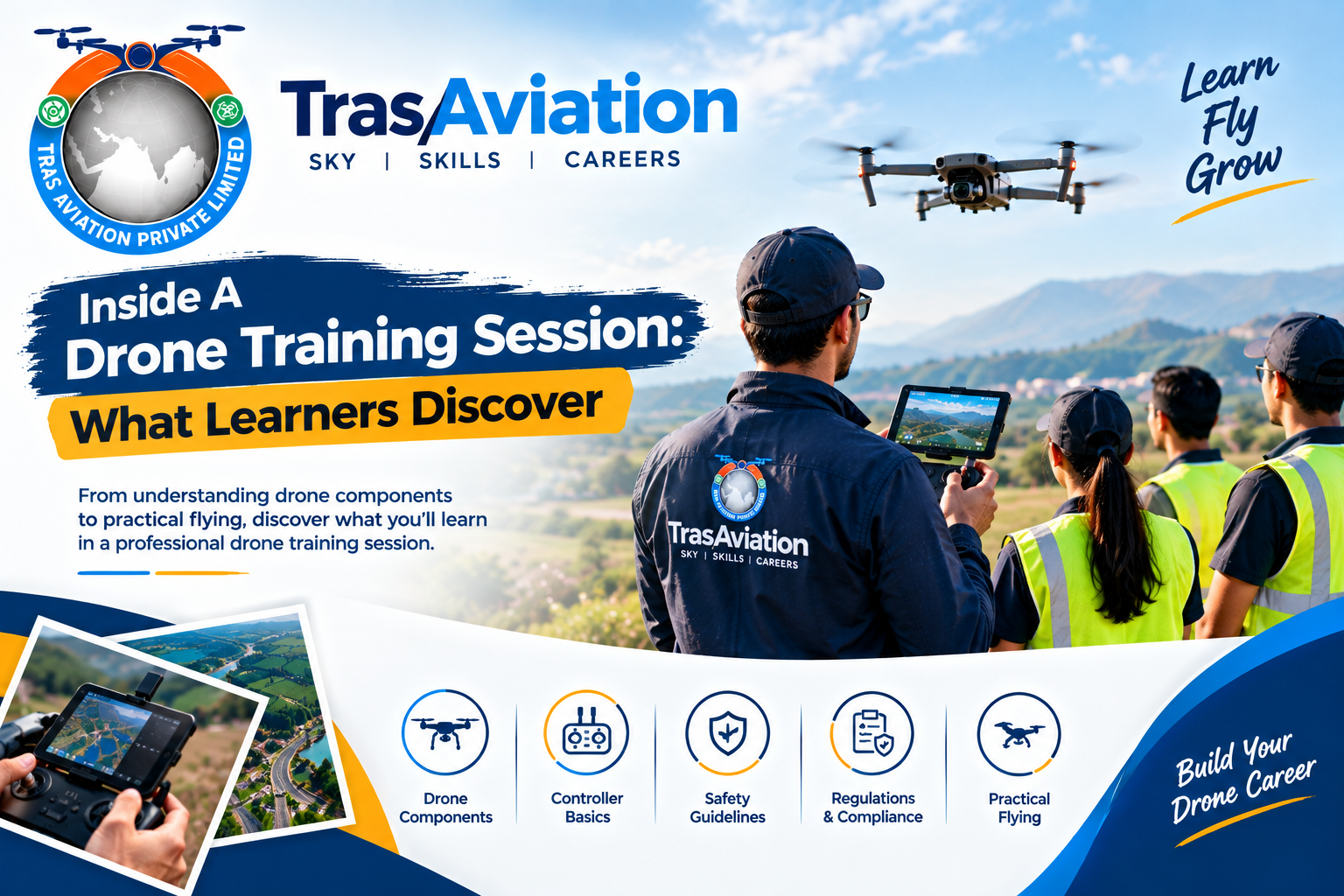
The goal of professional drone pilot training is to provide trainees with the skills to control and systematically operate a drone in a responsible and safe manner. The training covers the drone components and the planning and execution of safe flight.
Students will learn about:
- Drone components and systems
- Operation of a remote controller
- Planning a flight
- Performing a pre-flight inspection
- Landing and takeoff techniques
- Airspace knowledge
- Weather
- Battery management
- Emergency measures
- Post-flight inspection
- Basic troubleshooting
The DGCA Remote Pilot Training Syllabus contains both theoretical and practical lessons on airspace, weather, aerodynamics, equipment maintenance, safety management, emergency procedures, payload, and drone data.
This proves that drone education beyond learning the movements of a remote controller is important.
Read Also :- Best Drone Courses in Dwarka to Build a Successful Drone Career
Importance of Practical Drone Training
The amount of practical training is usually the first thing students notice when comparing different drone learning institutions.
Though thorough, online reading provides theoretical knowledge, but hands-on training helps students know the practical application of the learned concepts. Equipment familiarity and mastery of control, coordination, focus, and decision-making skills can be developed.
Practical training possibly includes one or more of the following activities:
- Setting of a drone
- Checking batteries
- Component inspection
- Controller set-up
- Performing pre-flight checks
- Practicing a controlled take off
- Maintaining stability
- Practicing a safe landing
- Addressing a few challenges
- Post flight inspection
DGCA’s training guidance places an emphasis on practical training and control of a remotely piloted aircraft to include safe recovery of the aircraft in an emergency and a failure of the system.
For beginners, practical training can enhance confidence and the understanding of the safety control systems.
What Should You Look For in the Best Drone Certification Courses?
Deciding which is the top drone certification course can be tricky, but most students check the rankings and reviews of potential courses before they enroll. Most students agree that while the course name can be appealing, it doesn’t necessarily say how good the course is.
A good certification course should include hands-on experience and have a clear outline for the course. It should prepare you for your expected career path.
Things to consider before enrolling in a certification course:
Course outline
This should include relevant modules for the technical, operational, and safety aspects of drone use.
Hands-on Experience
Students should get adequate time under supervision to understand the equipment and learn how to operate it.
Instructors
Students should have experienced instructors to answer their questions and guide them toward correct operational practices.
Equipment
Students should have access to train with working equipment.
Training
Safety should continue to be a cornerstone of the Professional Drone Education.
Course Outcomes
Students should understand the credentials they will receive upon completion of the course.
According to the DGCA a Remote Pilot Training Organization is an entity authorized to provide remote pilot training for candidates applying for the relevant Remote Pilot Certificate.
Drone Training Should Focus on Small Classes
In a smaller class environment, instructors can provide hands-on assistance and constructive feedback to learners during practical sessions on operating drones.
Focus in controlling the drone socially and technically can be best developed through practical experience, as drone operation calls for a combination of hand-eye coordination, spatial awareness, and focus.
A smaller class makes it easier for students to learn to operate the drone without hindrance from as distracting environment. A smaller class also builds the confidence of students to answer questions and to repeat drills to practice.
TRAS Aviation demarcates itself from the competition by creating drone educational programs catered to practical application and career readiness, helping students build knowledge and gain confidence in the operational realm. TRAS Aviation’s existing courses cover DGCA small and medium rotorcraft, assembly and maintenance, aero-modelling workshops, and industry-ready offerings.
Advanced Drone Skills for Professional Careers
Basic drone pilot training is a place to start, but drone pilot training for those wishing to pursue a long-term professional career should include advanced training.
Advanced drone education offers students the opportunity to learn how drones are used for:
- Drone Surveying
- Mapping
- Infrastructure Inspection
- Construction Monitoring
- Agriculture
- Aerial Photography and Videography
- Data Collection and Research
- Mission Planning
- Industrial Inspection
- Unique drone operations
To use construction drones as an example, someone looking to build surveying and mapping skills might take a drone education course focused on surveying, while someone looking to build aerial photography or videography skills might enroll in a drone education course focused on media.
The goal of an advanced training course is to help students see how drone technology can assist in solving different industry challenges.
Drone Service Technician Course: A Technical Career Path
While flying drones is a recognized stream in the drone industry, other stream jobs including technical maintenance and troubleshooting will always be in demand.
A drone service technician training course focuses on the different technical aspects of a drone system. The course may cover drone systems, motors, propellers, batteries and power systems, sensors, and electronic components, flight controllers and other systems.
Technical training may include instruction on:
- Drone Inspection
- Identifying Parts
- Basic Troubleshooting
- Preventive Maintenance
- Battery Care
- Component Replacement
- Fault Finding
- Equipment Testing
This kind of training will be something people interested in electronics, mechanics, technology, and solving problems likely enjoy.
This training may also be used to complement pilot training. Possessing basic technical knowledge would allow a drone operator to evaluate the equipment and situation prior to the planned flight operation.
Career Paths Post Drone Training
There are many careers that can result from professional drone training provided the student has the right combination of skills and qualifications and of course the laws and regulations related to the employment.
Drone Pilot
Commercial drone operations may include photography, surveying, mapping, inspection, construction, and other projects.
Drone Surveying Professional
Drones can be used for surveying and mapping.
Drone Technician
People with a technical background may find opportunities available in drone maintenance, inspection, repair, and other related services.
Aerial Photography Professional
Drones are often used as a source for taking photos and videos for various graphic content.
Agricultural Drone Operator
Drones are widely used for monitoring and assessing crops.
Drone Entrepreneur
Experienced professionals with the knowledge to run a drone photography, mapping, surveying, and inspection business have many opportunities to start their own business.
Qualities of a Professional Drone Pilot
There are many skills required to safely and professionally do drone operations which is why completing a drone course is only the first step of many.
Flight Skills
To be a proficient drone pilot, you have to build your flight and control skills through practice.
Technical Knowledge
Knowledge of batteries, motors, sensors, controllers, propellers, and other components leads to effective equipment manipulation by pilots.
Safety Awareness
Professional drone operations require meticulous planning, equipment checks, environmental consideration, and responsible choice.
Regulatory Knowledge
Drone pilots should be aware of the regulations and operating norms pertaining to their drone category and the activity they propose to undertake.
Problem-Solving
Challenges of a technical or environmental nature can occur during drone operations, making troubleshooting and quick decisions of great importance.
Communication
Professional drone engagements often entail the cooperation of the client, engineers, surveyors, photographers, construction personnel, and others.
Fostering these skills while undertaking formal training will prepare learners for real-world assignments.
How to Choose a Drone Training Institute in South Delhi
Before choosing an institute, students must evaluate different training programs based on their career aspirations.
Evaluate the following:
- Course curriculum
- Practical flight training
- Technical training
- Continuing education
- Instructor experience
- Training equipment
- Safety education
- Certification
- Batch size
- Course duration
- Industry Applications
- Career guidance
- Practical exposure
Along this line, a student should decide whether to become a professional pilot, technician, surveyor, photographer, or specialized drone operator.
The right course should help a prospective learner with long-term goal attainment as opposed to a course offering general training.
Why Choose TRAS Aviation?
TRAS Aviation aims to develop learners with professional drone skills through practical and structured training. Our training incorporates a combination of drone education, practical experience, safety awareness, and industry-oriented knowledge.
The institute offers several programs such as DGCA certified rotorcraft training and assembly and maintenance courses, aeromodelling workshops, and industry-ready courses. The practical training, advanced simulation, experienced trainers and real world flight training are part of TRAS Aviation’s training approach.
One of major elements for learners, who are looking for the Best Drone Training Institute in India, is to choose a training company that offers real world flying opportunities in addition to their structured training approach.
Build a Professional Career with Drone Training
There are plenty of untapped opportunities in the Indian drone ecosystem in construction, agriculture, infrastructure, surveying, mapping, media, inspection, public safety, and technology. As companies start to implement drone solutions, the need for trained professionals who have practical and technical skills will exist for the foreseeable future.
The Best Drone Training Institute in India can assist the students in developing the flight and safety skills, as well as the technology and professional skills.
For potential students looking for drone certification, professional pilot, or drone service technician training, the most important factor should be if the training fits their career goals and offers the required practical exposure.
TRAS Aviation specializes in career focused drone training for aspiring students who wish to obtain a drone related degree or a technical vocational course to enter the booming drone industry.
FAQ
1. What are the markers for a reputable drone training institute in India?
Training should be practical, instructors should be experienced, and safety should be taught. The Best Drone Training Institute in India should offer practical training and certification-based courses that ensure a drone training focused career. Such an institute is TRAS Aviation.
2. What are the Best Drone Certification Courses in India?
The best drone trainer certification course should cover operations, safety, regulations, and hands-on training that should assist the trainee in achieving the license, as well as building the right career.
3. What is a drone service technician course?
This course trains the candidate on a drone’s components, inspection, and repairs as well as the maintenance of the drone.
4. Is drone pilot training a worthwhile career in India?
Yes, there are so many opportunities for trained drone pilots in infrastructure, construction, surveying, inspection, mapping, photography, agriculture, and more.
5. What is the average length of a drone pilot training course in India?
Training and certification courses differ in duration depending on the drone certification pathway. The candidate should look into the practical hours and consider the training courses’ requirements before enrolling.
6. Why should I choose TRAS Aviation for my drone training?
TRAS Aviation offers hands-on practical experience and career-focused drone training. Their training courses cover safety, the construction of drones, and how to operate drones in a professional manner.

Related Posts